Not Every Restaurant Equipment Sale Belongs in the Same Cart
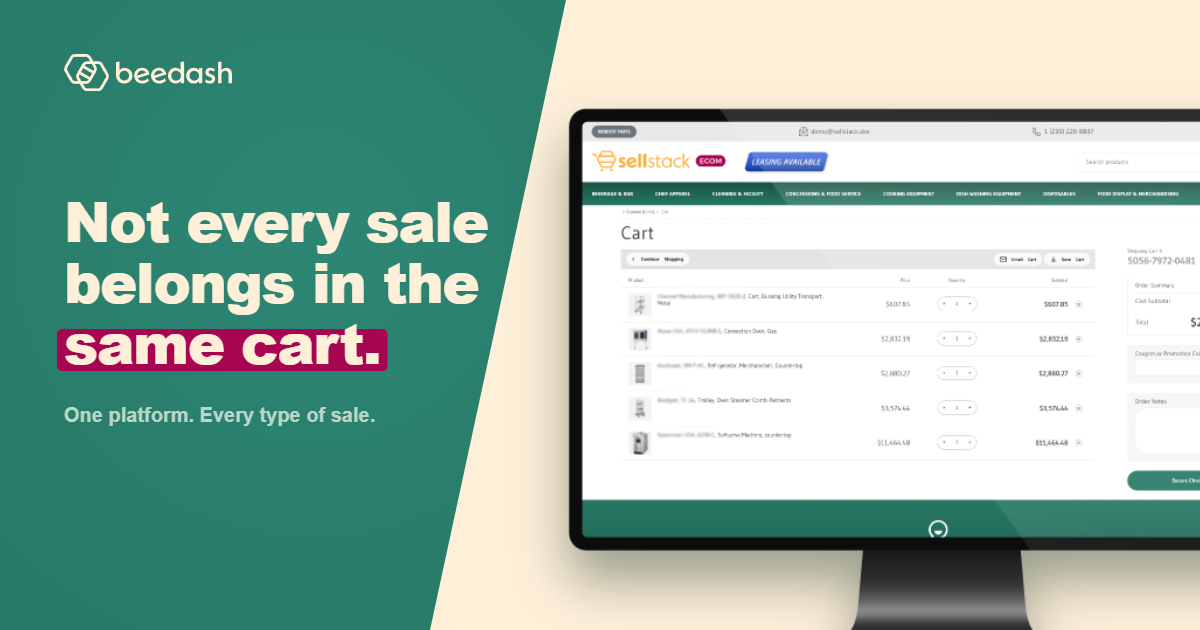
Not Every Restaurant Equipment Sale Belongs in the Same Cart.
Some products are ready for checkout. Others need a quote, customer-specific pricing, freight review, or a rep. Dealer websites need to support all of it.
Restaurant equipment dealers are not choosing between eCommerce and traditional sales. Many are trying to bring complex sales models online without flattening them into one generic checkout flow.
For some products, a cart is exactly what the customer wants. For others, the sale depends on freight, account pricing, specs, availability, or a rep’s review.
The challenge is not whether dealers should sell online. It is whether their dealer website can support the way they actually sell.
The problem is not eCommerce. It is one-size-fits-all eCommerce.
Many restaurant equipment dealers already sell online successfully. Checkout works. Customers buy. Orders move.
The problem shows up when the same checkout workflow gets applied to every order — regardless of the product, the customer, the freight situation, or the pricing model. A dealer with a well-built eCommerce channel for parts and accessories may find that the same flow creates issues when a high-value equipment order moves through it without freight review, rep involvement, or customer-specific pricing in place.
These are the kinds of problems dealers can run into when the workflow does not match the product, customer, freight, or pricing model. Fraud exposure on automated high-value orders, freight costs that surface after payment has been captured, and margin compression when pricing is public when it should not be — none of these are inevitable, but they can all result from applying the wrong workflow to the wrong type of sale.
The stronger position is not avoiding eCommerce. It is building a restaurant equipment dealer website that supports more than one way to sell.
Where checkout works for restaurant equipment dealers
For many products, full checkout is the right path. Parts, accessories, standard supplies, smallwares, and repeat orders tend to have consistent pricing, predictable freight, and customers who want to complete the transaction quickly. When pricing, freight, inventory, and fulfillment are predictable, full checkout can handle the entire buying experience cleanly.
Dealers who build eCommerce channels around these product types can create real advantages: catalog-driven discovery, faster order cycles, and a buying process customers are more likely to return to. A well-built sales order management and eCommerce setup, applied to the right products, benefits both the dealer and the customer.
For dealers with a large catalog of parts and supplies, checkout is not a workaround. It can be the right tool.
Where quote requests or rep review can help
For some dealers and some equipment categories, a quote step makes sense before pricing, freight, and payment are finalized.
Orders where the final number depends on the customer relationship, where freight varies by delivery location or access requirements, where the product requires configuration or spec confirmation, or where rep involvement is part of how the dealer operates — these are situations where a quote workflow can reduce risk and improve the buying experience.
A quote or rep-review step can reduce exposure to instant automated checkout risk on certain high-value orders, but it does not eliminate all fraud risk. What it does provide is a point of review before anything is charged — which matters when a liftgate requirement, a limited-access delivery location, or a high-cost delivery area could change the order economics significantly.
Depending on how the dealer operates, this step may apply to most equipment or only to a subset of sales.
Why customer-specific pricing matters online
For many dealers serving contract customers, national accounts, or buying groups, customer-specific pricing is part of how the relationship works.
A national account customer does not expect to see the same price as a general visitor. A contract customer has negotiated terms that should be reflected automatically when they log in. A dealer managing multiple customer segments may need different pricing visibility rules for different accounts — some seeing list prices, others seeing negotiated rates, and some seeing no prices at all until they have been identified.
Customer-specific catalog and pricing management supports how many dealers already operate. An online platform that cannot handle these models forces the dealer to work around the system rather than with it.
Why the dealer business model should drive the workflow
Restaurant equipment dealers operate across a wide range of business models. Some are primarily online-first, with large catalogs and checkout-driven revenue. Some are quote-driven, with most sales moving through a rep at some point. Some are relationship-driven, serving long-term contract customers. Some are project-driven, working on kitchen installations and equipment packages.
Many are some combination of all of these.
Some dealers need both checkout and quote workflows on the same platform, while others may lean more heavily toward checkout, quote-first, customer-specific pricing, or sales-assisted workflows depending on how they operate. The workflow should follow the sale, not the other way around.
That is the idea behind a dealer-centric, modular technology stack — not every dealer needs the same configuration, and the platform should reflect that.
What a flexible dealer website should support
A modern restaurant equipment dealer website needs to be capable of more than a standard eCommerce build.
It should support a complete, searchable online product catalog — so customers can find products and the dealer can be discovered through search. It should support full checkout where pricing, freight, and fulfillment are predictable. It should support quote requests and rep review where they fit. It should support customer-specific pricing and account-based buying for contract customers and national accounts. And it should support a buying experience that fits the way the customer actually shops — whether that is self-service checkout or a rep-assisted path.
The same platform should handle all of these, because most dealers need more than one of them. The Beedash customer showcase includes examples of FE&S dealers with different online models, categories, and business needs.
Beedash supports the way each dealer actually sells
Beedash works with restaurant equipment dealers whose online selling models are not all the same. Some need a stronger digital catalog. Some need checkout. Some need quote-first workflows. Some need customer-specific pricing, contract account controls, freight review, or a combination of all of these on one site. Beedash supports the way each dealer actually sells, giving customers a modern online experience without forcing every order through the same path.