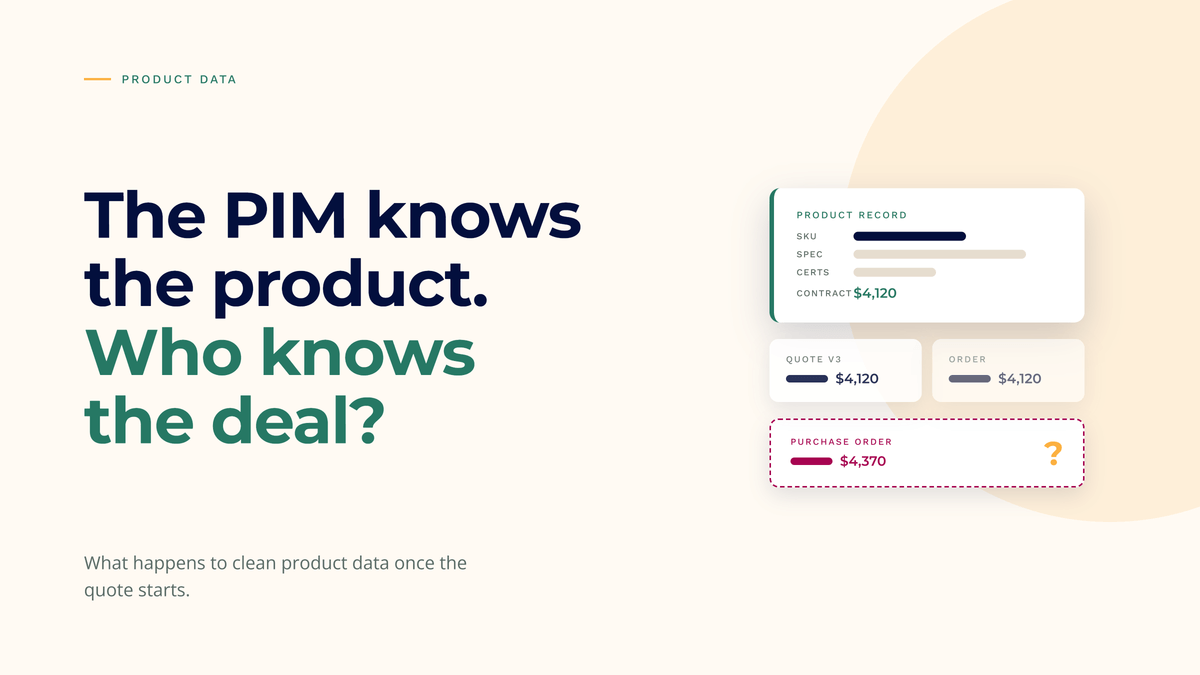
The PIM knows the product. Who knows the deal?
What happens to clean product data once the quote starts.
Key Takeaways
- A PIM, or product information management system, governs the product record: what a product is, and what it costs a given customer. It is not a system of record for the transaction.
- The expensive problems live after the catalog: in the quote that gets revised, the order that gets split across vendors, and the contract price that has to survive down to a line item.
- Every handoff creates another copy of the data. Every copy is a chance for last quarter’s number to survive into this quarter’s purchase order.
- Four parties share one blind spot: the dealer pays first, the manufacturer loses sight of its own product, the rep becomes the reconciliation layer, and the buying group can’t prove its contract was ever applied.
- Omnichannel syndication doesn’t close the gap. It’s a retail feature. Foodservice channels are relationships with negotiated contracts, not destinations receiving one public price.
- The fix is four layers on one spine: a governed product record, pricing that knows who’s asking, quotes that read live data, and orders that flow instead of being re-keyed.
- The question to ask: what happens to my deal after the product data? If the answer is “export to Excel,” the PIM centralizes the catalog and leaves the costly problems where they are.
The case for a PIM in foodservice equipment has been made: get the product data out of PDFs, spreadsheets, and the veteran rep’s head and into one governed catalog. It’s the right first move. But the catalog isn’t where the damage shows up. The manufacturer who published a clean price sheet in January is still receiving purchase orders in June at the old number. The rep covering forty dealers is re-explaining the same accessory compatibility forty times. And the buying group that negotiated a hard-won contract price has no reliable way to know whether it ever reached a quote.
A PIM fixes none of that, not because it’s a bad PIM, but because a PIM is built to know the product. The deal is a different thing: a quote that gets revised, an order that gets split across vendors, a contract price that has to survive all the way down to a line item.
All of it happens after the product data, and that’s where everyone loses sight of it.
Credit where it’s due: the catalog problem is solvable
Product data in this industry is uniquely messy. Beedash alone maintains a managed catalog of 450,000+ products, built from spec sheets designed to be printed, not queried. A PIM turns that into one governed record per product, and the value compounds downstream: a discontinued model, a revised cut sheet, or a new price list published once and arriving at every dealer that carries the line. The manufacturer’s data holds. The rep stops being the human spec sheet.
A PIM built for this industry goes a step further and carries relationship pricing: contracted product lists for the franchise, the hospital system, or the buying group member, custom pricing per catalog, automatic recalculation when a manufacturer’s price sheet changes.
That is enough value that most evaluations stop right there, which is exactly the moment to keep going, because the deal is about to leave the catalog.
Two questions a PIM answers. One it can’t.
A product can be completely accurate in the PIM and still be wrong on the quote and the purchase order. That’s because a PIM answers what is this product and what does it cost this customer with authority. But the third question every deal runs on, what’s happening with it right now?, isn’t a data question. It’s a workflow, and it begins the moment someone opens a quote.
| The question | Answered by a PIM? | Why |
|---|---|---|
| What is this product? | Yes | Specs, certifications, and accessory relationships are exactly what the product record is built to govern. |
| What does it cost this customer? | Yes, in an industry-built PIM | Contract lists and relationship pricing sit alongside the catalog and recalculate when a price sheet changes. |
| What’s happening with it right now? | No | Quote versions, approvals, order status, and vendor acknowledgements are workflow, not product data. |
A foodservice quote is assembled, not picked. Equipment, accessories, freight, installation, and service get bundled by rules that depend on the customer, the group, and the vendor, then revised until it’s accepted. A PIM can supply every line item’s data and price; it has no concept of the quote itself: its versions, its status, who approved it, what changed between draft two and draft three. The accepted quote then becomes an order that gets split across vendors, acknowledged, slipped, and invoiced, and asking a PIM where an order stands doesn’t parse.
The PIM is the system of record for the product. Nothing in it is the system of record for the transaction.
Every handoff creates another copy of the data.
That’s a scope boundary, not a flaw. A PIM that tried to be an order manager would be worse at both jobs. The trouble is what usually fills the gap: a person copying model numbers and prices from one screen into another. Every copy is a chance for last quarter’s number to survive into this quarter’s order, and every copy happens out of sight of everyone with a stake in it.
Four seats at the table, one blind spot
Sits closest to the gap and pays first
The quote is built from a copy of the catalog, the order is re-keyed from a copy of the quote, and the discrepancy surfaces when the vendor’s invoice doesn’t match the PO. The margin that looked fine at quote time turns out to have been a typo.
Loses sight of its own product the moment it leaves the catalog
The record it worked to publish gets copied into a quote, the quote into a PO, and what comes back is a superseded model number at a price from two revisions ago, plus a return, a credit memo, and a strained dealer relationship. Everything upstream was right; the cost still lands here.
Lives in that gap professionally
Running a dozen parallel back offices across a territory, each dealer with its own spreadsheet, its own stale price sheet, its own version of which accessory fits which unit. The rep’s real value is knowing the products, reading the operator, shaping the spec. All of it gets buried under being the reconciliation layer.
Has the most at stake and the least visibility
The group’s entire value to its members is the contract: the negotiated price, the rebate, the program terms. That contract has to survive all the way from the negotiating table to a line item on a member’s quote, built by someone in a hurry from whatever price sheet was closest. If it didn’t, the member overpaid, the group’s value went unproven, and nobody found out. And a group that can’t see what its members bought under the program can’t prove compliance to its manufacturer partners, can’t reconcile rebates with confidence, and can’t walk into the next negotiation with the volume numbers that would win a better deal.
Four parties, one shared blind spot: the stretch between the product record and the purchase order. The instinctive response is to push the product record further downstream and hope it covers the distance. That’s the detour worth avoiding.
The omnichannel detour
The PIM industry’s answer to “what happens after the product data” is omnichannel: syndicate the same clean record to every channel from one source. That’s a retail feature. It assumes channels are destinations that all receive the same product at the same public price, when a foodservice dealer’s channels are relationships: buying groups with negotiated contracts, sub-dealers with their own customer lists, national accounts whose price depends on which path the deal came through. Not every equipment sale belongs in the same cart, and most of the valuable ones don’t belong in a cart at all.
Syndicate a flawless feed to a storefront that can’t take a quote request, honor a contract price, or hand the order to a vendor, and the result is a modern catalog with the same manual back office behind it. For manufacturers and buying groups, that means perfect product content and no idea what happened to it.
The fix isn’t broadcasting the record to more places. It’s keeping the deal attached to the record.
Keep the deal attached to the data
A platform built for this industry has four layers, each reading live from the one before it.
-
One governed product record
Every product, spec, certification, and accessory relationship maintained once, so a correction made today is what every downstream system sees today.
-
Pricing that knows who’s asking
Contract lists, buying-group terms, and dealer-specific rules held as structured data alongside the catalog, so “what does this cost” has one computable answer per relationship instead of one per spreadsheet.
-
Quotes that read the live data
The current record and the current contract price pulled at the moment the line item is added, each revision preserving what was presented and approved at that point in time, so the same inputs produce the same quote no matter who builds it or when.
-
Orders that flow instead of being re-keyed
The accepted quote becomes the order and routes to vendors and into accounting without anyone re-typing a model number or a price. Every re-key eliminated is an error class eliminated.
When the four layers share one spine, the blind spot closes for everyone at the table: the dealer’s quote and PO agree, the manufacturer’s product reaches the quote as published, the rep quotes from one source of truth, and the buying group’s contract stops being a document and becomes a rule, applied to every member’s line item, every time.
This is how Beedash is built: a governed catalog with contract and custom pricing in it, plus a quote-to-order flow that carries the accepted quote into an order on that same data. That flow exists today, so the deal does not have to be copied out of the product and pricing foundation to move forward.
The next generation of the system is extending that spine deeper into quoting and order management, with stronger automation, tighter integrations, and greater visibility as the order moves toward fulfillment, including the program-level visibility buying groups are asking for. Those capabilities are being developed in partnership with the manufacturers, suppliers, dealers, and buying groups whose deals run through it.
One question, four ways to ask it
The basics of choosing a PIM still apply. But the evaluation comes down to one further question, with a version for every seat at the table.
-
For a dealer or wholesaler
What happens to my deal after the product data?
If the answer is “export to Excel and carry on,” the PIM will centralize the catalog and leave the expensive problems exactly where they are.
-
For a manufacturer or rep
When a dealer says they have my data, do they have it at the point of quote, or just in the catalog?
That’s the difference between a PO that reflects what was published and one that reflects what somebody remembered.
-
For a buying group
Was the contract price actually applied, and can anyone show you?
If not, the group is asking its members and its manufacturer partners to take the value on faith.
A PIM that can’t answer those questions isn’t the wrong choice. It’s the first part of the platform, and that’s worth knowing before the contract is signed, not after.
A PIM is the foundation. Beedash already carries that foundation into a quote-to-order flow, and the system is continuing to deepen the connections that follow.
Frequently asked questions
What is a PIM in foodservice equipment?
A PIM, or product information management system, is the governed system of record for the product itself: specs, certifications, images, accessory relationships, and, in an industry-built PIM, the contract price that applies to a given customer. It replaces the spec-sheet PDFs, spreadsheets, and rep knowledge that product data otherwise lives in.
Does a PIM handle quoting and order management?
No. A PIM can supply every line item’s data and price, but it has no concept of the quote itself: its versions, its status, who approved it, or what changed between revisions. Order status is the same story. That’s a scope boundary, not a flaw: a PIM that tried to be an order manager would be worse at both jobs.
What is the difference between a PIM and a quote-to-order platform?
A PIM is the system of record for the product. A quote-to-order flow is the system of record for the transaction. It carries the accepted quote into an order that routes to vendors and into accounting without anyone re-typing a model number or a price. The two work as layers on one spine, not as alternatives.
Can a PIM apply buying group contract pricing?
An industry-built PIM can hold the contracted product list and recalculate it when a manufacturer’s price sheet changes. What it can’t do on its own is prove that price reached a line item on a member’s quote. That requires the quote to read the contract price live, at the moment the line is added.
Isn’t omnichannel syndication the answer to what happens after the product data?
Omnichannel is a retail feature. It assumes channels are destinations receiving the same product at the same public price. A foodservice dealer’s channels are relationships: negotiated contracts, sub-dealers, national accounts whose price depends on the path the deal came through. Syndicating a flawless feed to a storefront that can’t take a quote request leaves the manual back office exactly where it was.
What should a foodservice dealer ask when evaluating a PIM?
What happens to my deal after the product data? If the answer is “export to Excel and carry on,” the PIM will centralize the catalog and leave the expensive problems exactly where they are. A manufacturer or rep should ask whether a dealer has their data at the point of quote or only in the catalog. A buying group should ask whether the contract price was actually applied, and whether anyone can show them.
Want to see what happens to your deal after the product data? Talk to Beedash.