AI Search Is Answering Your Customers Before They Ever Click
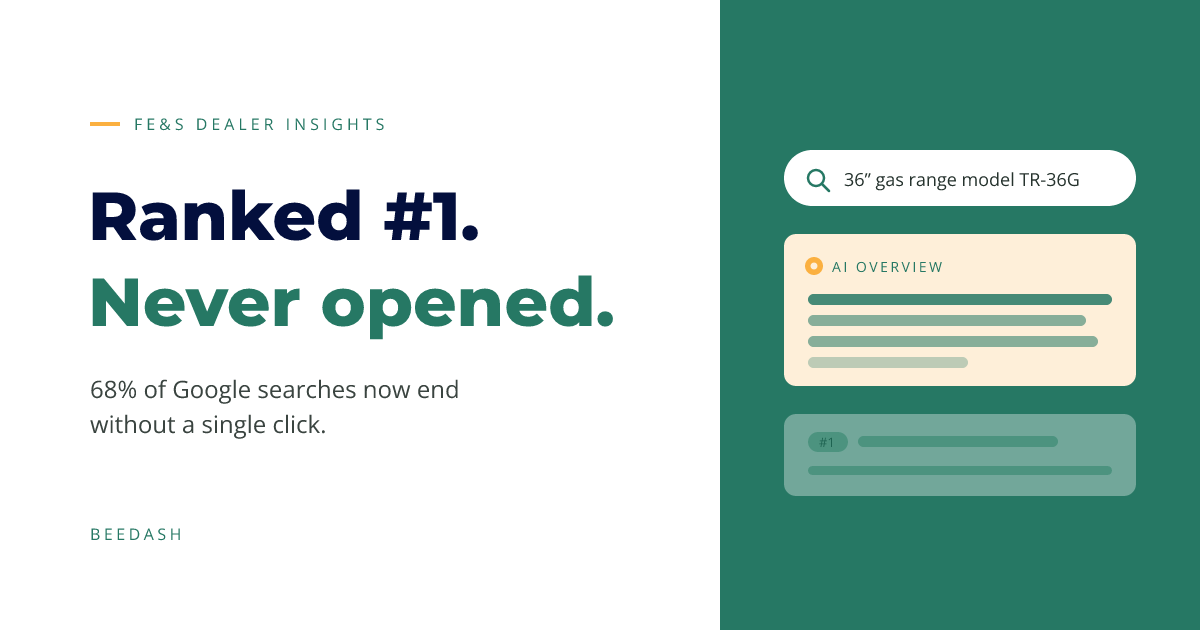
Your product page can rank first — and nobody has to open it.
A kitchen manager searches your exact model number. Google already has an answer. It pulled that answer from a manufacturer spec sheet, a competitor’s listing, or a review site. Nobody opens your product page — the one with your price, your availability, your quote request button.
This isn’t a ranking problem. Your page can sit at the top of the results, and a customer can still skip it. Google already answered their question, so they never had a reason to click anything.
Key Takeaways
- 68% of Google searches now end without a click — and that’s before an AI Overview even shows up on the page.
- When an AI Overview does appear, click-through drops by roughly 60%.
- Only 276 of every 1,000 Google searches now send a click to the open web. That’s down from 374 two years ago — a 23% decline.
- This isn’t unique to one industry. Publishers have watched Google referral traffic fall over a third since late 2024. The same mechanism now reaches product and “how does X work” searches too.
- Complete, structured product data gives a dealer’s site a real shot at earning a citation in an AI answer. It also helps the site show up in the Google-owned surfaces — Maps, local listings, Shopping — that increasingly stand in for a results page.
Google Used to Send You the Customer. Now It Tries to Be Their Last Stop.
We looked at this shift in general terms in an earlier piece on Google’s AI Overviews. This one goes deeper on what actually keeps a dealer’s product pages visible.
A Google results page used to be an index — a list of destinations, where Google’s job ended at the click. It’s increasingly a destination in its own right — an answer surface where the click is optional. Google, frankly, doesn’t want it.
That didn’t happen in one update. It’s the sum of several surfaces, and each one absorbs a category of search that used to leave. AI Overviews sit above the results and write the answer themselves. The citation links sit small enough to read as decoration. AI Mode goes further and replaces the results page with a conversation. At I/O 2026, Google said Search itself now centers on answers, not links. There’s no toggle back to the old experience. Featured snippets and “People Also Ask” were the earlier version of the same move. They keep the next question inside Google’s own page instead of sending it anywhere. A lot of commercial searches work the same way: hours, location, “does this fit,” “who carries this.” Google answers with its own surface — Maps, the local business pack, Shopping — not a dealer’s page.
The scale of it is no longer subtle. As of mid-2026, 68% of Google searches end without a click at all. That’s up more than seven points in two years — the fastest move since anyone started tracking it. Out of every 1,000 searches, only 276 clicks now reach the open web, down from 374 as recently as 2024. When an AI Overview actually appears on a search, click-through falls by roughly 60% on that search alone.
This isn’t a phase Google is likely to walk back. Every click that leaves Google hands attention to someone else.
Every question Google can answer on the page is a session it keeps and monetizes itself. ChatGPT and Perplexity already proved people will accept an answer with no links. Google either matches that or loses the search. Either way, the practical result for a dealer is the same: fewer of the visits a website used to get for free.
What Actually Still Gets Read When Nobody Clicks Through
An AI answer has to come from somewhere. The AI pulls together the clearest, most complete, most consistently structured version of the answer it can find. That’s not necessarily the prettiest page, or the one with the most backlinks.
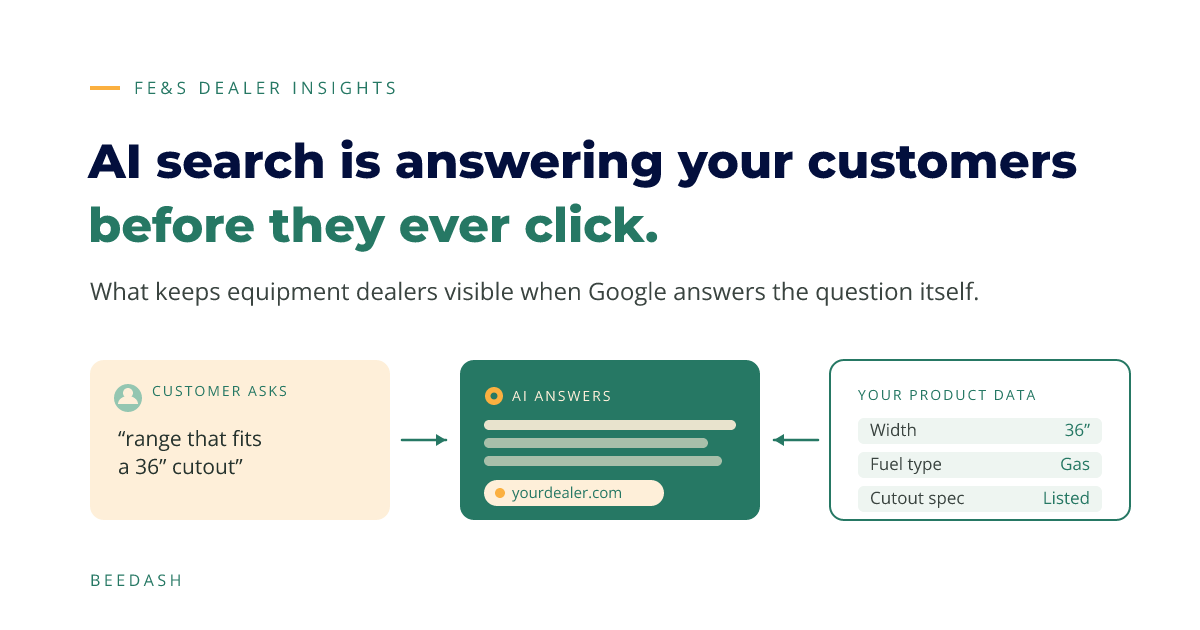
For a foodservice equipment dealer, that’s a specific test. Can the AI answer “will this fit a 36-inch cutout” or “does this come in gas or electric”? Only if that spec actually lives on the page, in a format the system can parse. Not buried three clicks deep in a manufacturer PDF. Not missing because nobody entered it at all. The customer never sees your page, but the system reading it on their behalf absolutely does.
Why Dealers With Thin Catalog Data Disappear From the Answer Entirely
This is where the AI search shift stops being a marketing problem and becomes a product-data problem. In our own dealer research, roughly 15–20% of online SKUs carry critical data gaps. Think missing specs, inconsistent categories, attributes that never made it off the manufacturer’s spreadsheet. That was already costing dealers customer confusion and weaker search performance before AI Overviews existed.
Now the same gaps decide whether an AI cites a dealer at all. An AI system won’t guess at a missing dimension. It won’t reconcile three conflicting spec sheets on a customer’s behalf either. It will simply cite whichever source did have a clean answer. Picture a dealer whose team typed catalog data onto the site by hand. It came from a messy PDF, and someone entered it inconsistently, a few fields at a time. That’s exactly the dealer this shift makes invisible — the same underlying problem behind how operators actually search for equipment. They’re not looking for a model number. They’re looking for an answer.
Why the Fix Starts With the Data Behind Your Site, Not the Design
None of this means a redesigned dealer website, a blog cadence, or more backlinks won’t help. They still matter — a stronger site is exactly what’s behind why some dealer sites quietly send customers to competitors. But they’re solving a different problem than the one AI search actually tests. AI search tests something narrower: whether your product information is accurate, complete, and consistent enough for a machine to trust.
That’s a harder problem than it sounds, because most dealers don’t control the raw material. Manufacturer data arrives in dozens of formats, on different update schedules, with different gaps. Usually it’s the dealer’s team, not the manufacturer, that ends up reconciling it by hand.
Build the Foundation an AI Can Trust
This is the layer we built Beedash to fix. Our product data platform pulls manufacturer data — specs, categories, images, pricing — into one structured catalog before it reaches your website. That makes the information behind each product page complete, instead of whatever survived manual entry.
We can’t promise a citation in every AI-generated answer — no one honestly can, including Google. Complete, structured product data gives your site a real shot at becoming the source an AI cites. Without that data, the site goes unnoticed — the answer just wasn’t there to find.
The same logic carries over to the Google-owned surfaces that now stand in for a results page. Think Maps, your local business listing, Shopping. Those run on the same kind of information: accurate categories, current hours, correct product data. Showing up there isn’t a separate project from fixing your catalog data. It’s the same underlying problem, solved once.
Want a plain read on where your catalog data would hold up? Talk to Beedash about building the foundation AI can trust.
Sources
- SparkToro, “In 2026, Less Than One Third of Google Searches Still Send a Click” (June 2026) — zero-click rate, clicks per 1,000 searches, and AI Overview click-through impact.
- Search Engine Land, “Google zero-click searches reach 68% in early 2026: Study” (2026) — secondary coverage of the SparkToro data above.
- Axios, exclusive Chartbeat data, “Small publishers hit hardest by search traffic declines” (March 2026) — Google Search referral decline, Dec 2024–Dec 2025, and AI-chatbot referral share.
- Similarweb, “The Impact of Generative AI on Publishers” — news-site organic traffic decline since AI Overviews launched.
- Google, Sundar Pichai’s Google I/O 2026 keynote recap (May 2026) — AI Mode scale and Search’s shift toward answers over links.