Nobody buys a model number
After the last post on foodservice equipment product data went out, a manufacturer president wrote back with a question that has stuck with me since: you talk about how foodservice sells, but isn’t the equally important question how the operator buys?
He’s right. And once you start looking at product data through that lens, you see the real gap. Everything we covered in Part 1 — the catalogs, the spreadsheets, the specs — is organized around what the manufacturer makes. But an operator doesn’t walk in asking for a specific model number. They walk in with a problem: a space, a menu, a volume target, and a budget. The model number is supposed to be the answer at the end of that conversation, not the starting point.
The questions an operator asks before buying foodservice equipment
Watch a good equipment conversation unfold, and the sequence is remarkably consistent. It almost never starts with the product. And this isn’t just true for big cooking equipment — the same pattern holds whether the operator is buying a deck oven, a walk-in cooler, a worktable, or a custom-cut cutting board. The product changes; the shape of the decision doesn’t.
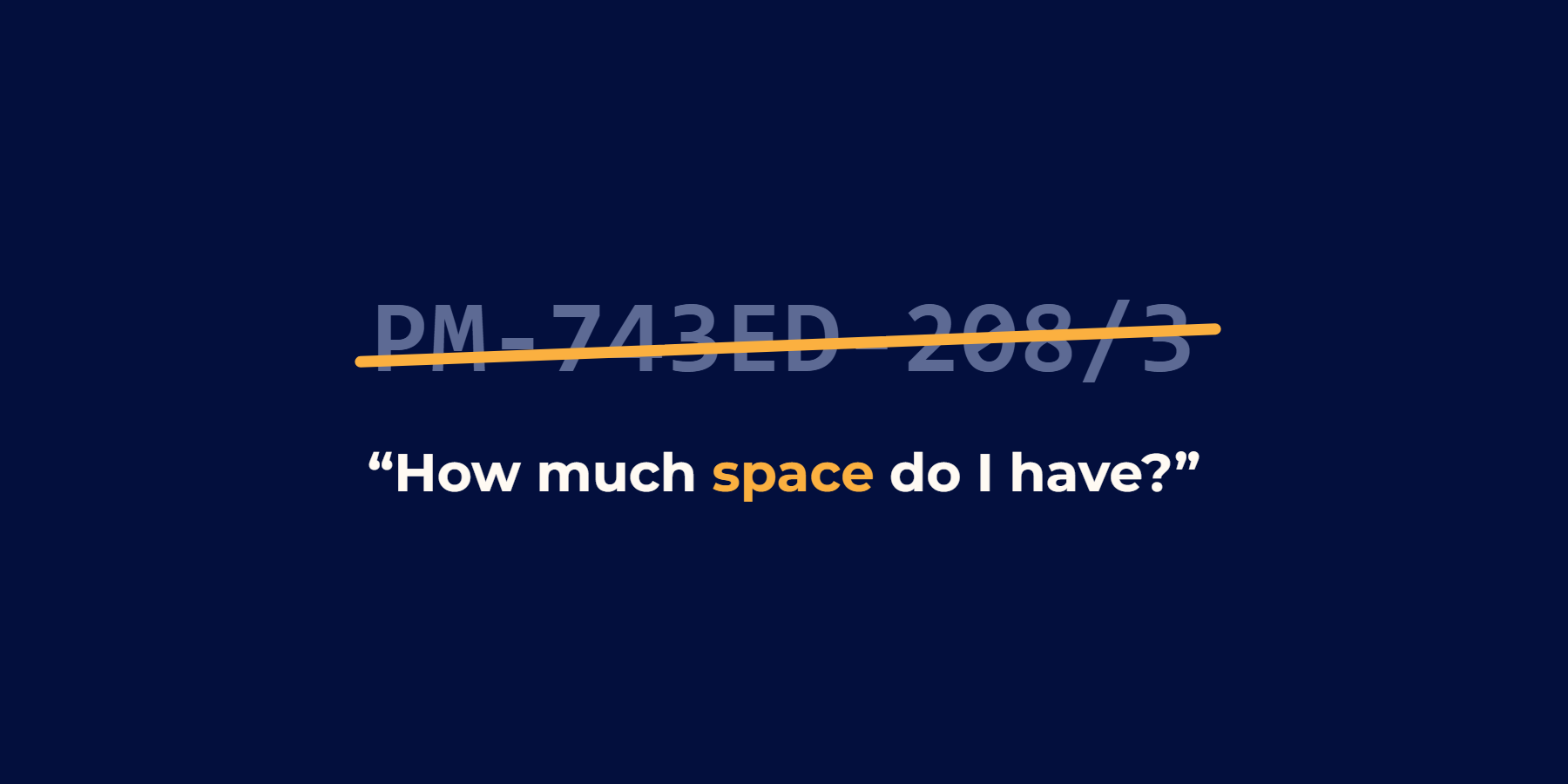
How much space do I have?
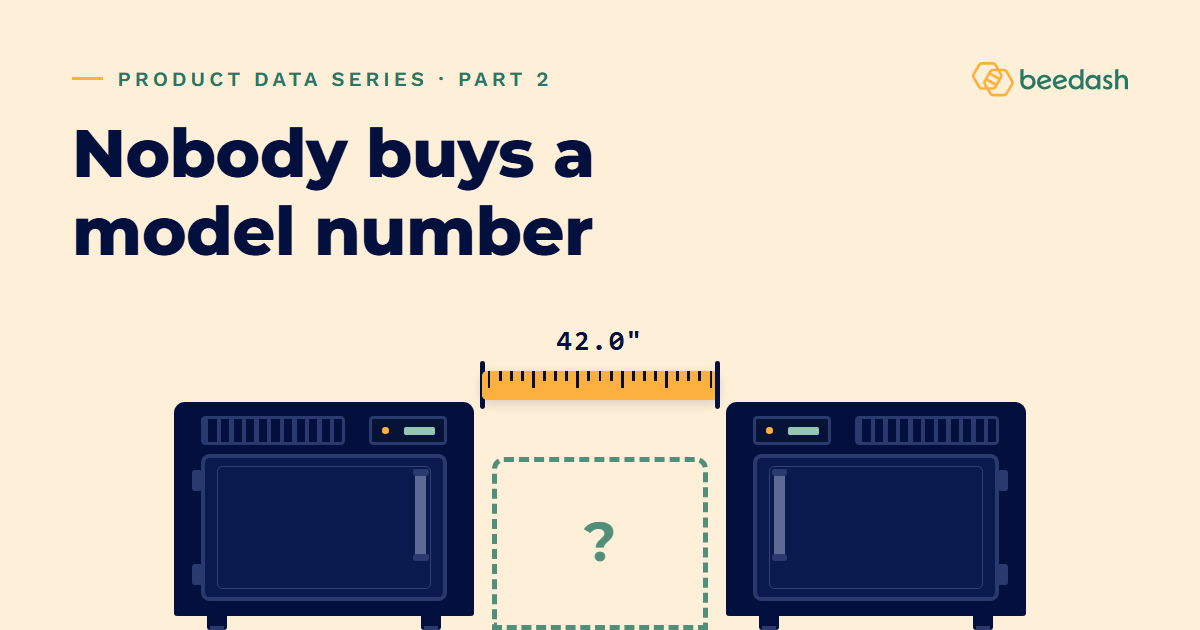
This is the first question, and it quietly shapes everything after it. An operator with 42 inches of floor space and an operator with an open kitchen line are not choosing from the same set of options, even if they need the exact same output. Tight on width? You go taller, stacking capacity vertically. Room to spread out? A wider footprint often works better, because it improves the workflow of loading and unloading during a rush. The same logic drives a walk-in: the box gets designed around the building, not the other way around, and every panel dimension follows from that first measurement.
How much do I need to produce — or hold?
Not in abstract terms. In covers, in pies, in pans per hour on a Friday night, in cases of product that need to stay cold through a weekend delivery gap. Output for cooking equipment, capacity for refrigeration, throughput for prep — it’s the same question wearing different clothes. A good rep does this math in their head. The catalog rarely does it at all.
What power do I have?
The electrical service in the building shapes more purchases than most spec sheets account for. An operator with three-phase 208 available is in a different buying situation than one with single-phase 240, and finding this out late is one of the more expensive mistakes in an equipment deal.
What does my ventilation allow?
Hood type is jurisdiction and equipment dependent, and it can swing the total project cost dramatically. Some equipment qualifies for lighter ventilation requirements based on emissions testing; some requires the full treatment. The certification details that determine this are exactly the kind of information that gets lost as data moves downstream.
Who’s working the line?
Equipment height matters more than it usually gets credit for. The right working height depends on the configuration and on the humans using it every day. It’s a real purchasing factor, and it rarely appears as structured data.
Space, output, power, ventilation, people. Then budget shapes the tradeoffs among them. Every answer narrows the next question. That’s not a catalog browse. That’s a decision tree.
And the tree doesn’t only apply to six-figure equipment. A custom cutting board is the same conversation in miniature: what size is the station, what’s being cut on it, what thickness holds up to the work, what material meets the health code. A walk-in freezer is the same conversation at building scale: the available footprint, the storage volume, the door placement that fits the workflow, the refrigeration sized to the load. Most products in this industry that get configured, sized, or optioned follow this shape. Which means most manufacturers have a version of this problem — and a version of this opportunity.
Why equipment catalog data can’t answer these questions
Here’s the uncomfortable part. Take almost any configurable product line in almost any catalog in this industry — ovens, walk-ins, worktables, boards — and try to answer those operator questions from the data alone. You mostly can’t.
The capacity figures are often buried in description text instead of living as fields you can calculate with. The electrical options exist as separate SKUs, or as line items a rep knows to add, rather than as structured choices attached to a base product. The certifications that determine ventilation requirements show up as abbreviations in a spec string, if they show up at all. And the relationships — which stand fits which unit, which accessories apply to which configuration, which models are really one product in different arrangements — tend to live mainly in the heads of experienced reps.
That last part is the one worth worrying about. In many dealerships, the operator-question-to-right-configuration logic is rep experience, and some of it walks out the door when a veteran rep retires. The catalog holds what the products are. The people hold how to choose between them. Those are two different kinds of knowledge, and as an industry we’ve mostly digitized only the first one.
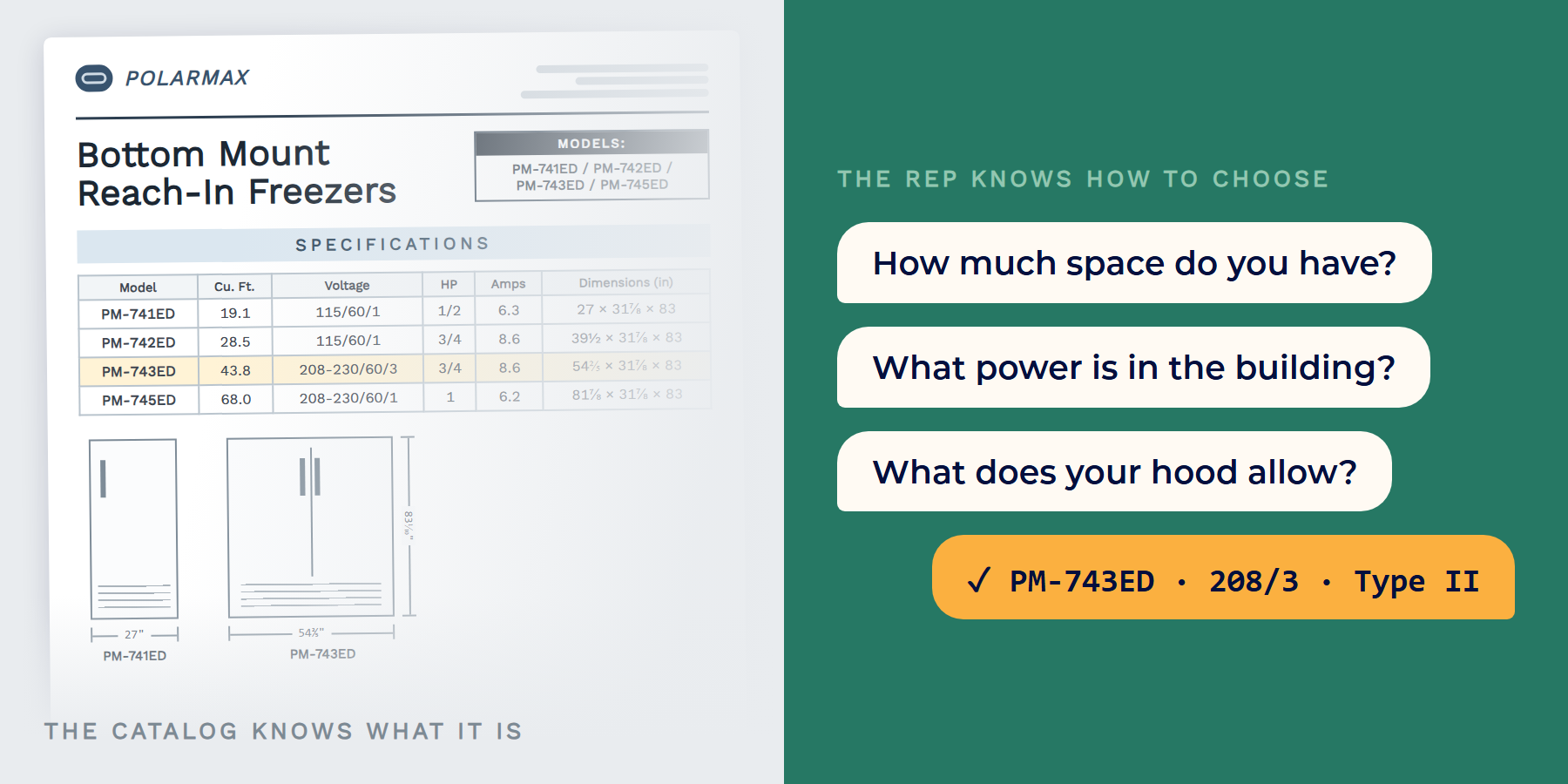
Answering the operator’s questions from the data
Configurable product data is what our new product database is being built around. Our current Beedash product catalog management platform already gives dealers a managed catalog of 450,000+ products with pricing tools built in. The next generation goes deeper into the structure of the products themselves. Here’s what that looks like in practice.
A product database that holds the whole decision
A configurable product, done right, isn’t a folder of related SKUs. It’s a base product plus a set of decisions: which options exist, what each one changes, what each one costs, and what order the decisions come in. Power available narrows the eligible configurations. Space determines whether you solve for height or width. Certifications follow from the configuration and tell you what ventilation path you’re on.
A foodservice equipment configurator that sells like your best rep
When the data is structured that way, a foodservice equipment configurator stops being a gimmick and starts being the digital version of that good rep conversation — walking an operator or a dealer through the questions in the right order and arriving at a complete, correct, buildable spec.
Pricing that holds up
A base oven configured for three-phase power costs one number. Swap to single-phase and the build goes custom — same price on some lines, a different one on others, and a longer lead time either way — and that’s true whether the configuration came from a rep who’s done it a thousand times, a website nobody’s watching, or an AI assistant working on a dealer’s behalf. The same configuration gets the same price no matter which rep is quoting it, or whether the price sheet in front of them is this month’s or last year’s. Same inputs, same quote, every time.
The rep stays. The busywork goes.
None of this replaces the rep. The judgment calls — reading the operator’s real priorities, knowing when the stated budget is soft — stay human. What changes is that the mechanical part of the conversation gets faster and safer, and nothing gets lost between the conversation and the order.
That handoff, from configured product to priced quote to placed order, is where I’m heading next. Part 3 follows the deal into the quote itself: where margin quietly leaks in a typical foodservice deal, why it so often isn’t discovered until the purchase order lands, and what we’re building to catch it earlier.
As before, if any of this matches what you’re seeing in your business — or doesn’t — tell me. The best material in this post came from someone who asked a sharper question about the last one.
— Kari