The Quote Was Accurate. The Margin Still Slipped.
Three ordinary changes to a $40,000 quote, 13% of the expected gross profit gone, and what dealers can do about it.
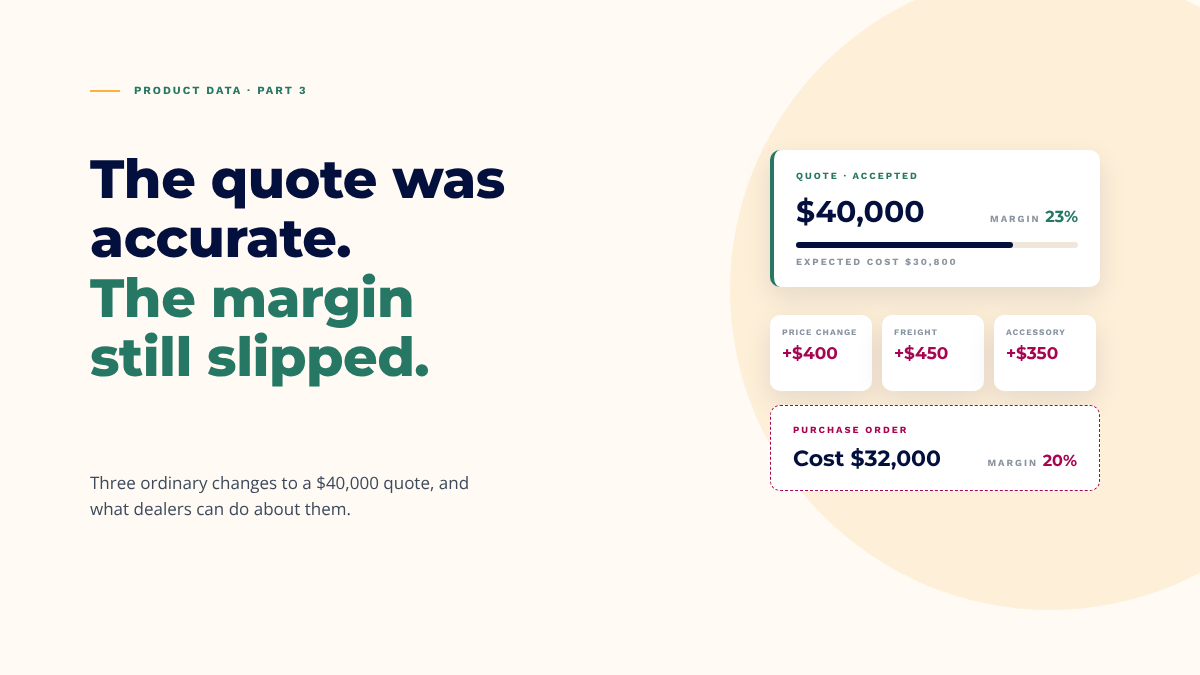
A dealer prepares a $40,000 equipment quote. The expected cost is $30,800, leaving $9,200 in gross profit, or a 23% gross margin. The specifications have been reviewed, the pricing is accurate, and the customer accepts the proposal.
Before the order is placed, three costs surface. A manufacturer’s price increase adds $400. Revised delivery arrangements add $450 in freight. A required accessory omitted from the original quote adds another $350.
The customer still pays $40,000. But the dealer’s cost has increased to $32,000, leaving $8,000 in gross profit. The margin has dropped from 23% to 20%.
13% of the anticipated gross profit is gone.
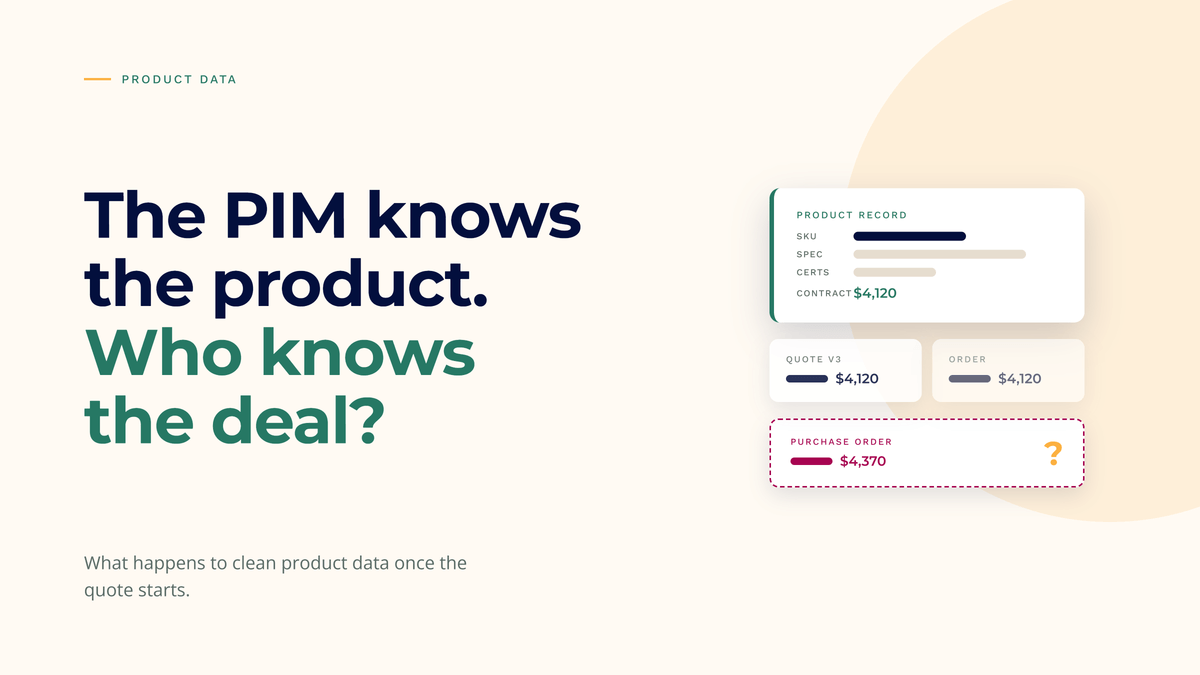
The invoice still says $40,000. Revenue reports look as expected, while financial statements reflect a lower margin without necessarily revealing what changed between proposal and purchase order.
Dealers encounter three kinds of cost differences: expenses anticipated in the quote, costs they consciously absorb to support a customer or honor a commitment, and costs discovered too late to reconsider. The third category deserves attention.
The quote and the costs behind it often live in different places. Without a deliberate check, one can change while the other stays the same.
As Part 1 and Part 2 of this series explored, accurate manufacturer information and the customer’s actual equipment needs must eventually come together in a quote. What happens to that information afterward has a direct effect on profitability.
The Accessory Nobody Quoted
Consider a combi oven. Beyond selecting the appropriate model, there are decisions about voltage, gas or electric operation, stands, water filtration, accessories, and installation requirements. Some choices are optional; others are necessary for the equipment to operate as intended.
A water filter, stand, or conversion kit required from the start can be missed in the original proposal and surface only when purchasing confirms the order or installation begins. By then, the customer has approved a price. The dealer must decide whether to absorb the cost or revisit the proposal.
The information may be spread among a specification sheet, an accessory catalog, manufacturer pricing, and installation instructions. Experienced salespeople know where to look, but finding and reconciling those details takes time.
A useful catalog connects equipment to required and compatible options, with enough information to select and price them. That makes it easier to deliver a complete quote before the customer approves it.
When October Quotes Meet January Pricing
Equipment projects don’t always move quickly. A quote prepared in October can remain open when a manufacturer’s January price increase arrives because construction schedules, financing, or customer decisions shifted.
Meanwhile, dealers are navigating individual manufacturer agreements, buying-group programs, negotiated discounts, and special project pricing. The correct purchasing cost for one dealer may differ from the published price or the cost available to another dealer.
The salesperson’s October cost was correct when quoted; the January price file now shows something different. That deserves attention, but it doesn’t automatically mean the customer price should change.
The dealer might have inventory purchased at the earlier cost, project price protection, or a special agreement. Where appropriate, the dealer and manufacturer can discuss available options before deciding how to handle the customer commitment.
There is a big difference between choosing to absorb a price increase and discovering afterward that you already did.
Effective pricing management means knowing which cost applies, when it became effective, and which outstanding quotes deserve another look.
Freight Doesn’t Always Follow the Original Plan
A dealer might quote several items expecting them to ship together. When one manufacturer runs late and the customer needs the others immediately, separate shipments replace the original plan and the freight estimate changes.
Other complications are familiar to anyone in foodservice equipment: liftgate requirements, limited-access locations, inside delivery, oversized equipment, or shipments coming from different manufacturer locations.
Manufacturer freight programs also have minimums and exceptions. A revision to the order can change whether an allowance applies.
The original estimate wasn’t wrong when it was made. The circumstances changed, so the assumption deserves another look.
Freight affects profitability regardless of which department calculates it. Keeping assumptions visible makes it easier to decide how additional costs should be handled.
One Revision Can Affect More Than One Line Item
A consultant revises the equipment schedule. The customer selects a different refrigeration configuration. A manufacturer discontinues a product, requiring a substitution.
A replacement may have different utility requirements, dimensions, accessories, freight characteristics, or purchasing costs. If the product changes but its related information doesn’t, the proposal can become inconsistent.
This gets particularly challenging when product selections, cost calculations, and customer proposals are maintained in separate documents or applications.
A salesperson might update a model in the proposal while the original accessory remains on another line. Purchasing may later identify the difference, but by then the customer has approved the pricing.
A clear revision history shows which version the customer approved, what changed, and which related costs or specifications were reviewed. It also saves time when questions arise during purchasing, delivery, or installation.
What Does That Look Like Across a Business?
Now consider a dealer with $10 million in annual equipment sales.
Each percentage point of gross margin represents $100,000 in gross profit. If a similar three-point difference occurred across the entire sales volume, the impact would be $300,000.
That’s an illustration, not an estimate of typical losses. FEDA’s 2024 Financial Benchmarking Survey reported a 23.1% overall gross margin for the typical dealer, using 2023 financials. That dealer-wide figure isn’t an equipment-quote benchmark; rebate accounting can also affect comparisons.
Dealers also make deliberate pricing decisions, including accepting lower margins on particular jobs for sound commercial reasons.
Many dealers also earn manufacturer and buying-group rebates through purchasing programs. Those rebates contribute to profitability but don’t explain what changed within an individual quote.
The useful question is whether the difference reflects a deliberate choice or a cost that surfaced after the decision was made.
Before You Buy Software, Follow One Quote
Before considering another platform, start with an exercise that requires no new software: follow one completed equipment quote.
Choose a project that’s representative of your business, preferably one with several products and at least one revision. Gather the original proposal, revised versions, purchase orders, supplier confirmations, and final costs.
Then look at six things:
-
Product selection
Was the information needed to select and configure the equipment readily available? Were options or accessories added after the initial quote?
-
Pricing
Which manufacturer costs and dealer agreements were used? Did pricing change before the order was placed, and was that change recognized?
-
Freight
What was originally estimated? How did that compare with the actual cost, and what changed along the way?
-
Revisions
How many times did the proposal change? When a product was substituted, were related specifications, accessories, and costs reviewed?
-
Information handling
How many places did employees need to visit to retrieve or verify information? Where was the same information entered more than once?
-
Profitability
Compare the expected gross margin with the actual result. For each difference, identify whether the cost was anticipated, deliberately absorbed, or discovered after the decision was made.
You might find that manufacturer price updates need a clearer review, freight assumptions aren’t revisited after an order change, or substitutions require too much manual checking. Those findings help prioritize improvements.
At Beedash, we work with dealers on the connections between product information, pricing, and quoting. That experience reinforces the importance of understanding how each business works before recommending changes.
Sometimes the next step is a clearer procedure; sometimes it’s better product information or better-connected systems.
Before buying another solution, follow one quote from beginning to end.
You may find that the most valuable improvements are hiding in the steps your team performs every day.
— Kari